|
|
|
|
|
FoAR 建筑风格度量指标构建:基于图文模型的设计量化分析方法 |
|
|
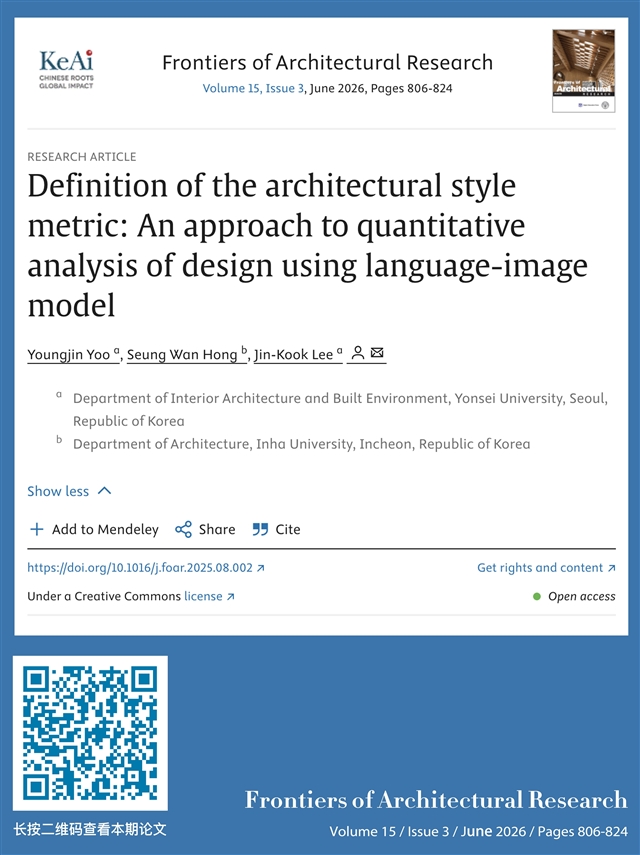
论文标题:Definition of the architectural style metric: An approach to quantitative analysis of design using language-image model
期刊:Frontiers of Architectural Research
作者:Youngjin Yoo , Seung Wan Hong , Jin-Kook Lee
发表时间:4 Aug 2026
DOI:10.1016/j.foar.2025.08.002
微信链接:点击此处阅读微信文章
FoAR是由高等教育出版社和东南大学建筑学院联合主办的全英文学术期刊
建筑学 / 城乡规划 / 风景园林
本刊已被 A&HCI / EI / CSCD / Scopus / DOAJ / CSTPCD 收录
中国科技期刊卓越行动计划 英文领军期刊
Manuscript Title
论文题目
Definition of the architectural style metric: An approach to quantitative analysis of design using language-image model
建筑风格度量指标构建:基于图文模型的设计量化分析方法
Authors
作者
Youngjin Yoo (a), Seung Wan Hong (b), Jin-Kook Lee (a)*
(a) Department of Interior Architecture and Built Environment, Yonsei University, Seoul, Republic of Korea
(b) Department of Architecture, Inha University, Incheon, Republic of Korea
Abstract
论文摘要
This study proposes Architectural Style Metrics (ASM), a CLIP (Contrastive Language-Image Pre-training)-based methodology for quantification of architectural design’s visual characteristics. To address the subjectivity and inefficiency of traditional architectural design analysis methods, ASM quantifies four visual features―curvature, saturation, transparency, and symmetry―by their relative positions between opposing states, generating comprehensive metrics including means, standard deviations, and feature outliers. The effectiveness of the methodology was validated through single/multi-image quantification and clustering analysis. The quantification consistently reflected perceptual visual characteristics, while clustering―based on a quantitative database of approximately 9000 images constructed in this study―yielded meaningful groupings with an average silhouette score above 0.5. The study further explores potential applications through the demonstration of ASM-based evaluation approaches for systematic analysis of architectural designs, among which classification achieved an accuracy of 87.2%. ASM offers interpretable and objective results without additional training or strict image constraints, enabling broad applicability. These results demonstrate ASM’s potential as a consistent and scalable methodology for data-driven design analysis.
本研究提出建筑风格度量指标(ASM),一套基于 CLIP(对比性语言 - 图像预训练模型)的方法体系,用以量化建筑设计视觉特征。针对传统建筑设计分析方法主观性强、效率偏低的问题,ASM 围绕曲率、饱和度、通透度、对称性四项视觉特征,依据特征对立状态之间的相对取值实现量化,输出均值、标准差、特征异常值等多项综合指标。研究通过单图与多图量化实验、聚类分析验证该方法的有效性,量化结果能够稳定反映人可感知的视觉特征;依托本研究构建的近 9000 张图像量化数据库开展聚类,得到具备阐释价值的分组结果,轮廓系数均值高于 0.5。本文进一步展示基于 ASM 的评估流程,探讨其在建筑设计系统性分析中的应用潜力,对应的分类任务准确率可达 87.2%。ASM 无需额外训练、对图像无严苛限制,输出结果具备可解释性与客观性,适用场景广泛。上述结果表明,ASM 有望成为一套稳定、可拓展的方法,支撑数据驱动下的建筑设计分析工作。
Keywords
关键词
Architectural style metrics / 建筑风格度量指标
Quantitative analysis / 量化分析
Language-image model / 视觉语言模型
Facade design / 立面设计
Visual features / 视觉特征
Sections Title
章节标题
1. Introduction / 引言
2. Literature review / 文献综述
2.1. Conventional approaches to architectural style analysis / 建筑风格分析的传统方法
2.2. Early AI-based approaches to quantitative style analysis / 基于人工智能的早期风格量化方法
2.3. Advancements of AI technologies in computer vision / 计算机视觉人工智能技术进展
2.4. Directions for advancing architectural style analysis / 建筑风格分析研究发展方向
3. Conceptual modeling for quantification of architectural styles / 建筑风格量化概念模型构建
3.1. Architectural style features for quantification / 适用于量化的建筑风格特征
3.2. Conceptual modeling of Architectural Style Metrics / 建筑风格度量指标(ASM)概念模型
3.3. Extension of Architectural Style Metrics for multiple image analysis / 面向多图像分析的建筑风格度量指标拓展
4. Development of Architectural Style Metrics / 建筑风格度量指标构建
4.1. Algorithm structure of Architectural Style Metrics / 建筑风格度量指标算法框架
4.2. Representation of Architectural Style Metrics / 建筑风格度量指标表达形式
5. Demonstration / 实例验证
5.1. Quantification of architectural style in a single design / 单一设计方案的建筑风格量化
5.2. Quantitative style definition from multiple designs / 基于多组设计方案的风格量化界定
5.3. Style classification through Architectural Style Metrics-based clustering / 基于建筑风格度量指标聚类的风格分类
5.4. Future applications of Architectural Style Metrics / 建筑风格度量指标应用展望
6. Discussions and conclusions / 讨论与结论
Illustrations
主要插图
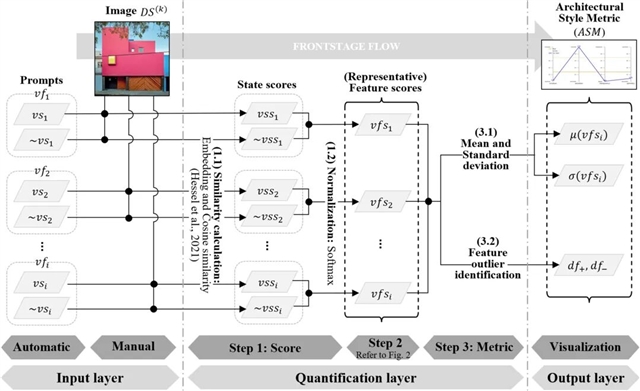
▲ 图 1:建筑风格度量指标量化算法。©本文作者
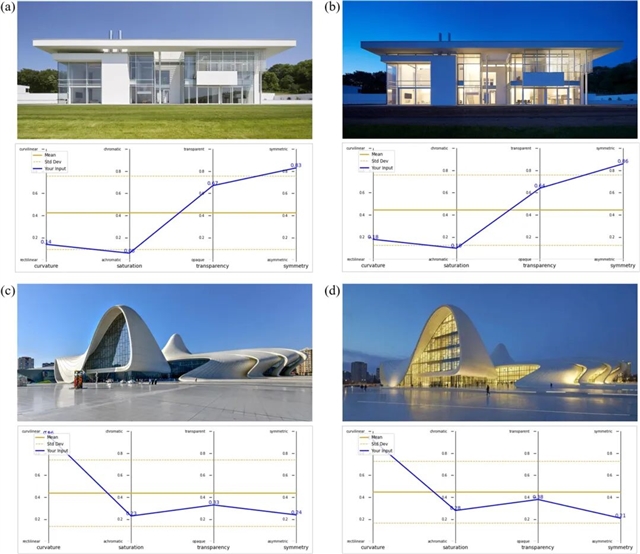
▲ 图 2:建筑风格度量指标计算结果示例。(a) 案例 1 日间效果图;(b) 案例 1 夜间效果图;(c) 案例 2 日间效果图;(d) 案例 2 夜间效果图。©本文作者
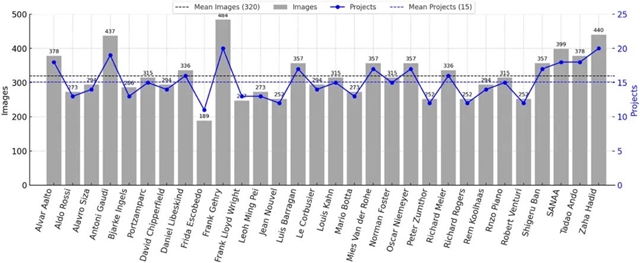
▲ 图 3:各建筑师对应的项目与图像数量分布。©本文作者
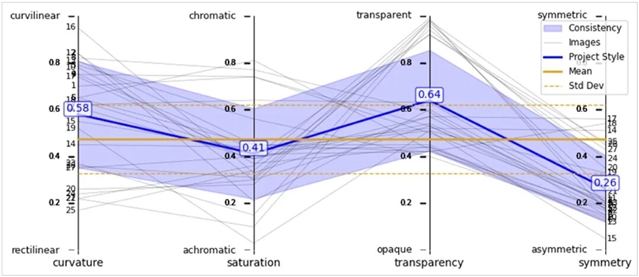
▲ 图 4:周泽荣博士大楼(位于悉尼科技大学)的建筑风格度量指标(ASM)图谱。©本文作者
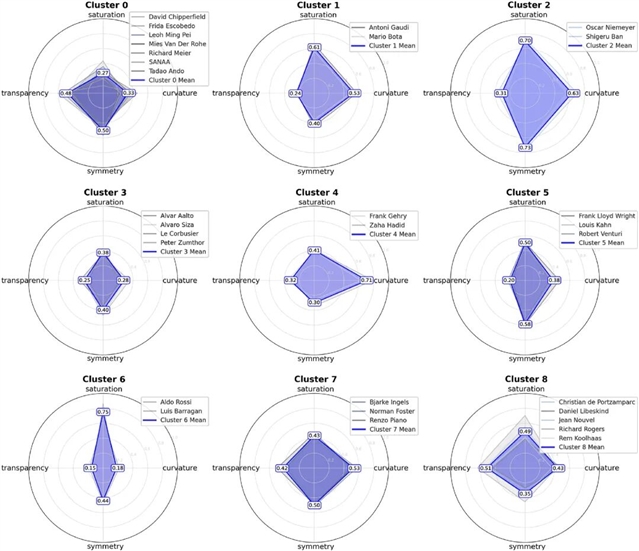
▲ 图 5:知名建筑师设计风格 K 均值聚类结果示例(k=9)。©本文作者
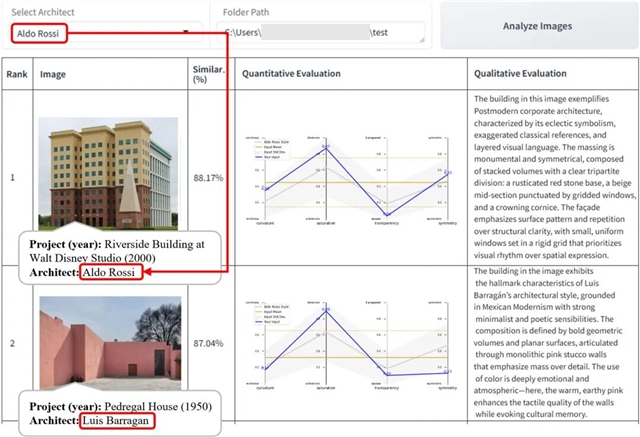
▲ 图 6:基于建筑风格度量指标(ASM)的设计评估示例。©本文作者
Authors Information
作者简介

Youngjin Yoo
Researcher
Korea Institute of Civil Engineering and Building Technology
Researcher of AI-aided Architectural Design Technologies
Seung Wan Hong
Professor
Department of Architecture
Inha University, Republic of Korea
Seung Wan Hong serves as a Professor in the Department of Architecture at Inha University, South Korea. He leads the Mind Computation Lab, a multidisciplinary research lab that explores the intersection of design computation, human behavior, artificial intelligence, and virtual environments. He primarily investigates the influence of new media on architectural design creativity. His research projects are funded by grants from the National Research Foundation of Korea (NRF) and the Korea Agency for Infrastructure Technology Advancement (KAIA). This works have been published in leading international journals such as Automation in Construction, Architectural Science Review, and Environment and Planning B.

Jinkook Lee*
Professor
Department of Interior Architecture and Built Environment
Yonsei University, Seoul, Republic of Korea
Professor in the Department of Interior Architecture and Built Environment at Yonsei University, possesses extensive research, development, and practical experience in related disciplines such as Housing and Built Environment, Interior Architecture, Architectural Engineering, Digital Design, and Design Computing.
After obtaining his B.S. and M.S. from Yonsei University, he earned his Ph.D. from Georgia Tech (Advisor: Chuck Eastman). In 2025, he was appointed as the Underwood Distinguished Professor at Yonsei University.
▼ 点击下方词条 | 往期精彩不容错过
#期刊快讯#系列
主编王建国院士团队荣获国家科技进步奖一等奖
JCR 2025 影响因子4.4建筑学第一
CiteScore 2025 指数上升为7.8
FoAR 被中国科技论文与引文数据库CSTPCD收录
FoAR 荣获2025科爱三项期刊奖
2025年度中国科学院分区表大类小类FoAR保持一区
FoAR 入选"卓越行动计划"英文领军期刊
FoAR 进入 EI 工程索引数据库
FoAR 在国际影响力 TOP 期刊榜单中排名稳步上升
#主办会议# 系列
会议回顾 | FoAR青年学者之夜
会议回顾 | 智汇浦江: FoAR青年学者学术沙龙
会议回顾 | FoAR专题会议:历史空间的跨媒介再现
会议回顾 | FoAR专题会议:面向气候环境可持续的街区设计
会议回顾 | 皖美遇见: FoAR青年学者学术沙龙
会议回顾 | FoAR专题会议: 高性能建筑维护结构
活动招募 | FoARxJoA建筑国际写作营
#年度报告# 系列
FoAR 2020年度报告
FoAR 2021年度报告
FoAR 2022年度报告
FoAR 2023年度报告
FoAR 2024年度报告
FoAR 2025年度报告
#新刊上线#系列
2025年第四期
2025年第五期
2025年第六期
2026年第一期
2026年第二期
2026年第三期
#FoAR投稿指南#系列
投稿流程
Guide for Author中文版
审稿流程及发表流程
如何提交修改稿
录用文章出版流程
#期刊知识科普#系列
SCI之父尤金·加菲尔德的传奇人生
国际核心期刊数据库大解析
如何使用最强工具Web of Science
如何发现一本好期刊
国内核心期刊有哪些
版面费与期刊影响力
期刊联络
高等教育出版社:010-58556484
东南大学:025-83795543
刊物邮箱:foar@pub.seu.edu.cn
FoAR英文期刊交流QQ群:21608832
在线投稿
www.editorialmanager.com/foar
刊物主页
http://www.sciencedirect.com/science/journal/20952635
http://journal.hep.com.cn/foar
特别声明:本文转载仅仅是出于传播信息的需要,并不意味着代表本网站观点或证实其内容的真实性;如其他媒体、网站或个人从本网站转载使用,须保留本网站注明的“来源”,并自负版权等法律责任;作者如果不希望被转载或者联系转载稿费等事宜,请与我们接洽。