
近日,浙江工业大学Bei Wang团队报道了加拿大西部注入诱发地震的前震产率与破裂成核。2026年8月27日出版的《科学》杂志发表了这项成果。
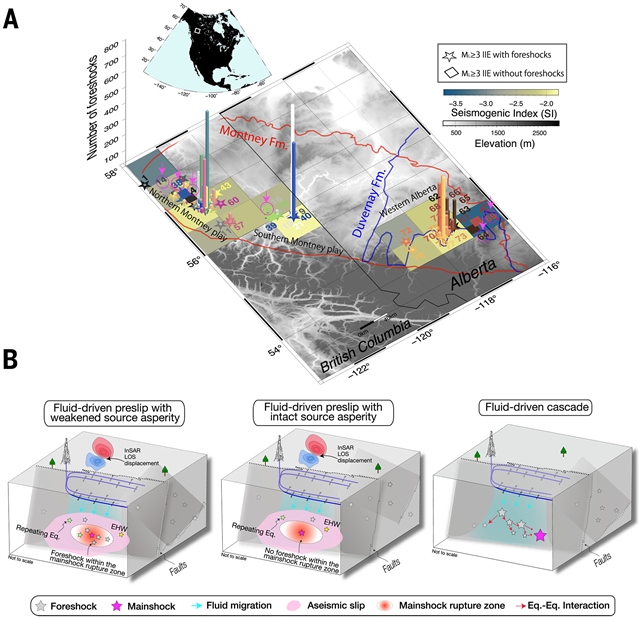
前震活动是交通灯协议(TLP)中减轻注入诱发地震(IIEs)地震风险的关键考量因素。然而,学界对IIE前震的发震过程仍知之甚少。利用增强的加拿大西部地震目录(2014—2024年),研究组分析了77个IIE序列,以统计描绘局部震级(ML)≥3级主震之前的前震模式。结果发现,92%的地震事件之前存在前震,前震产率和时空模式反映了流体注入、发震指数与断层应力状态之间的相互作用。
序列特异性分析阐明了三种成核模型:流体驱动的前滑伴随源区凹凸体弱化、流体驱动的前滑伴随源区凹凸体完好,以及流体驱动级联模型,突显了流体在促进主震破裂前的无震滑移和事件间应力传递中的核心作用。这些结果表明,IIE监测策略在空间上应取决于前震产率。
附:英文原文
Title: Foreshock productivity and rupture nucleation in injection-induced earthquakes in western Canada
Author: Bei Wang, Honn Kao, Hongyu Yu, Yan Jiang, Qiang Lin, Wenli Zhang, Jun Hua, Yushi Bai, Zhilong Chen, Peng Zhang, Ya Liu, Ryan Visser
Issue&Volume: 2026-08-27
Abstract: Foreshock activity is a key consideration in traffic-light protocol (TLP) to mitigate seismic risk from injection-induced earthquakes (IIEs). However, the seismogenic processes of IIE foreshocks remain poorly understood. Using an enhanced western Canada catalog (2014–2024), we analyzed 77 IIE sequences to statistically delineate foreshock patterns before local magnitude (ML) ≥ 3 mainshocks. We found that 92% are preceded by foreshocks and that foreshock productivity and spatiotemporal patterns reflect the interplay among fluid injection, the seismogenic index, and the fault stress state. Sequence-specific analyses elucidate three nucleation models: fluid-driven preslip with weakened source asperity, fluid-driven preslip with intact source asperity, and fluid-driven cascade, highlighting the central role of fluids in enabling aseismic slip and interevent stress transfer before mainshock rupture. These results imply that IIE monitoring strategies should be spatially conditioned according to foreshock productivity.
DOI: 10.1126/science.aed9893
Source: https://www.science.org/doi/10.1126/science.aed9893