
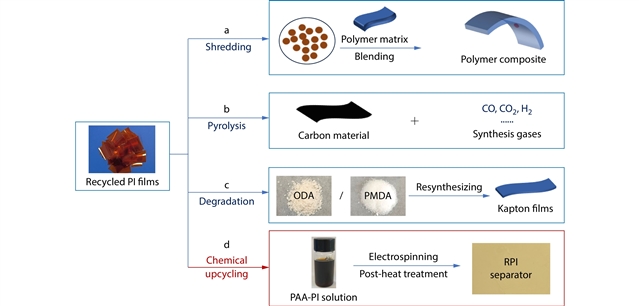
近日,中山大学张艺团队报道了低成本制备高性能聚酰亚胺隔膜:回收聚酰亚胺薄膜的高价值应用。这一研究成果发表在2026年9月1日出版的《中国高分子科学杂志》上。
随着全球对塑料循环回收和可持续发展的日益关注,化学升级回收正变得越来越重要。该过程可将废塑料转化为高价值产品,避免传统物理回收工艺中出现的性能下降和降级回收问题。聚酰亚胺(PI)是一种高性能聚合物材料,因其耐高温、良好的机械强度和优异的电解液润湿性,在锂离子电池隔膜领域尤为受到重视。然而,与传统锂离子电池隔膜(如聚乙烯/聚丙烯)相比,聚酰亚胺的单体成本较高且制备过程能耗较大,这限制了其更广泛的应用。
研究组提出了一种有效的策略,通过化学催化实现回收聚酰亚胺(PMDA/ODA型)薄膜的高值化应用:利用氢氧化锂催化回收聚酰亚胺中酰亚胺环的部分开环,将不溶不熔的回收聚酰亚胺转化为可溶的聚酰胺酸-聚酰亚胺体系(PAA-PI)。该体系进一步通过电纺丝工艺制备聚酰亚胺纳米纤维膜,并将其用作锂离子电池隔膜。所制得的隔膜在结构、热性能和机械性能方面与传统方法制备的PI隔膜相似,同时具有良好的孔隙率、电解液润湿性和电解液吸收率。
此外,使用该回收PI隔膜(RPI)制备的电池表现出优异的高倍率性能(5 C电流下为135.55 mAh·g-1)和长期循环稳定性(0.5 C电流下100次循环后为118.01 mAh·g-1,2.0 C电流下100次循环后为87.10 mAh·g-1),与传统PI隔膜制备的电池相比无显著差异,且性能优于使用商用Celgard 2500隔膜制备的电池,基本满足下一代锂离子电池的性能要求。该工作提出了一种低成本制备锂离子电池高安全性聚酰亚胺基隔膜的策略,实现了聚酰亚胺废弃物的高价值再利用,从而建立了一种符合绿色化学和可持续发展理念的工艺。
附:英文原文
Title: Low-cost Preparation of High-performance Polyimide Separators: High-value Application of Recycled Polyimide Films
Author: Ying-Hua Sha, Zi-Hao Huang, Jia-Shu Lin, Yan-Wei He, Chu-Ying Li, Hai-Tao Huang, Si-Wei Liu, Yi Zhang
Issue&Volume: 2026-09-01
Abstract: With growing global focus on plastic circular recycling and sustainable development, chemical upcycling is gaining importance. It converts waste plastics into high-value products, avoiding the performance degradation and downcycling associated with conventional physical recycling processes. Polyimide (PI) is a high-performance polymer material, particularly valued in the field of lithium-ion batteries as a separator due to its high-temperature resistance, favorable mechanical strength, and good electrolyte wettability. However, its broader application has been limited by the high cost of its monomers and the energy consumption of its preparation process compared to conventional lithium-ion battery separators such as polyethylene/polypropylene. Here, we propose an effective strategy for the high-value application of recycled polyimide (PMDA/ODA-type) films through chemical catalysis: using lithium hydroxide to catalyze the partial ring-opening of the imide rings in recycled polyimide, transforming the insoluble and infusible recycled polyimide into a soluble poly(amic acid)-polyimide system (PAA-PI). This system is further processed via electrospinning to fabricate polyimide nanofiber membranes, which are applied as separators in lithium-ion batteries. They exhibit similar structural, thermal properties, and mechanical properties to the PI separators prepared by the traditional method, while also possessing good porosity, electrolyte wettability, and electrolyte uptake. Furthermore, batteries prepared using this recovered PI separator (RPI) exhibit excellent high-rate performance (135.55 mAh·g–1 at 5 C current) and long-term cycle stability (118.01 mAh·g–1 after 100 cycles at 0.5 C current, and 87.10 mAh·g–1 after 100 cycles at 2.0 C current), showing no significant difference compared to batteries prepared with conventional PI separators, while outperforming batteries prepared with commercial Celgard 2500 separators, essentially meeting the performance requirements of next-generation lithium-ion batteries. This work presents a strategy for the low-cost production of high-safety polyimide-based separators in lithium-ion batteries, enabling the high-value reuse of polyimide waste and thereby establishing a process consistent with green chemistry and sustainable development.
DOI: 10.1007/s10118-026-3730-6
Source: https://www.cjps.org/en/article/doi/10.1007/s10118-026-3730-6/
Chinese Journal of Polymer Science:《中国高分子科学杂志》,创刊于1983年。隶属于中国化学会,最新IF:4.3
官方网址:https://www.cjps.org/
投稿链接:https://mc03.manuscriptcentral.com/cjps