
2026年9月2日,德国汉堡大学Manuel A. Friese等科学家在《自然》(Nature)发表研究,揭示了细胞内补体H因子(CFH)在中枢神经系统炎症中保护神经元的非经典功能。
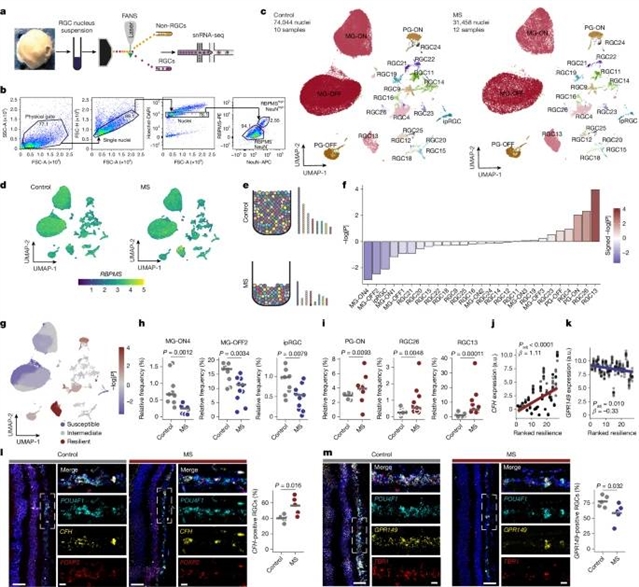
神经退行性变是多发性硬化(MS)——中枢神经系统最常见的慢性炎症性疾病——残疾的主要驱动因素。视网膜神经节细胞(RGCs)是眼睛中一类异质性的神经元群体,在MS中会发生退行性变,并为研究神经元亚型对炎症损伤的差异性韧性提供了模型。然而,这种差异脆弱性背后的神经元内在机制仍不清楚。在此,研究人员鉴定出细胞内补体H因子(CFH)在神经元中的神经保护作用。通过对MS供体和对照个体RGCs的单核RNA测序分析,他们发现CFH表达与RGC退行性变的内在韧性密切相关。机制上,CFH在视网膜和其他中枢神经系统神经元中响应炎症和氧化应激而被诱导,从而限制活性氧积累和脂质过氧化。CFH定位于内质网——神经元铁死亡过程中脂质过氧化的主要场所。其保护活性依赖于其C端SCR20结构域,不依赖于CFH的分泌,并且在补体成分C3缺失的情况下仍保持活性。这些发现揭示了CFH在神经元中一种非经典的细胞内功能。总之,研究结果将CFH鉴定为小鼠和人类中枢神经系统中神经元韧性的关键介质,并为炎症性神经退行性变提供了机制洞见,对MS治疗和更广泛的神经保护具有启示意义。
附:英文原文
Title: Intracellular complement factor H protects neurons during CNS inflammation
Author: Mayer, Christina, Woo, Marcel S., Sonner, Jana K., Binkle-Ladisch, Lars, Fischbach, Felix, Sekol, Patricia, Smith, Matthew D., Lucas-Ruiz, Fernando, Manteufel, Darwin, Mattern, Kuno M.-J., Pfeffer, Lena Kristina, Guo, Yubing, Siebels, Bente, Miguela, Albert, Vieira, Vanessa, Meurs, Nina, Bauer, Simone, Schwarz, Sophia, Wulf, Sonia, Mhlig, Anne Katrin, Engler, Jan Broder, Conrad, Marcus, Bareyre, Florence M., Wiech, Thorsten, Krasemann, Susanne, Glatzel, Markus, Zipfel, Peter F., Freiwald, Tilo, Calabresi, Peter A., Schirmer, Lucas, Friese, Manuel A.
Issue&Volume: 2026-09-02
Abstract: Neurodegeneration is a major driver of disability in multiple sclerosis (MS), the most common chronic inflammatory disease of the central nervous system (CNS)1. Retinal ganglion cells (RGCs), a heterogeneous neuronal population in the eye, undergo degeneration in MS and provide a model to study neuronal subtype-specific resilience to inflammatory injury2. However, the neuron-intrinsic mechanisms underlying differential vulnerability remain unclear. Here we identify a neuroprotective role for intracellular complement factor H (CFH) in neurons. Using single-nucleus RNA-sequencing analysis of RGCs from donors with MS and control individuals, we found that CFH expression was strongly correlated with intrinsic resilience to RGC degeneration. Mechanistically, CFH was induced in retinal and other CNS neurons in response to inflammatory and oxidative stress, where it limited reactive oxygen species accumulation and lipid peroxidation. CFH localized to the endoplasmic reticulum, a major site of lipid peroxidation during neuronal ferroptosis. Its protective activity was dependent on its C-terminal SCR20 domain, was independent of CFH secretion and was preserved in the absence of complement component C3. These findings reveal a non-canonical intracellular function of CFH in neurons. Together, our results identify CFH as a key mediator of neuronal resilience across the CNS in mice and humans and provide mechanistic insight into inflammatory neurodegeneration with implications for MS therapy and neuroprotection more broadly.
DOI: 10.1038/s41586-026-10981-y
Source: https://www.nature.com/articles/s41586-026-10981-y
Nature:《自然》,创刊于1869年。隶属于施普林格·自然出版集团,最新IF:69.504
官方网址:http://www.nature.com/
投稿链接:http://www.nature.com/authors/submit_manuscript.html