
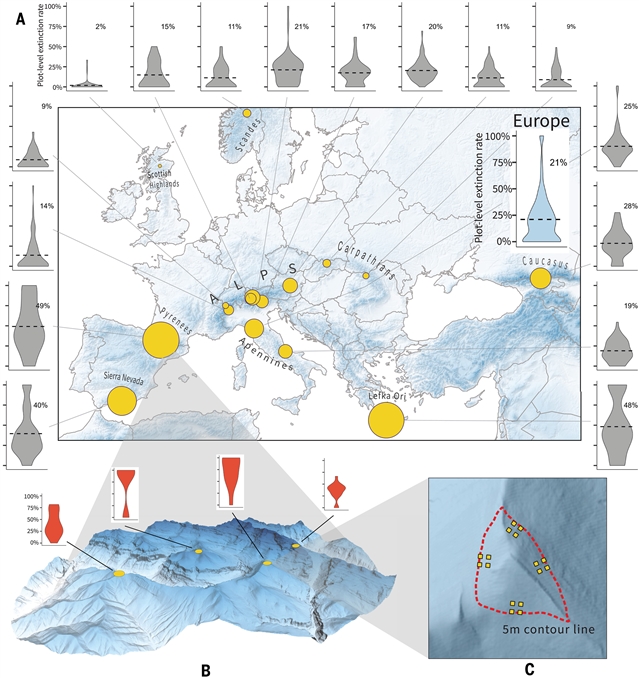
近日,奥地利维也纳大学Johannes Wessely团队揭示了欧洲山顶植物灭绝率上升。2026年9月3日出版的《科学》杂志发表了这项成果。
气候变化会提高高寒生态系统的植物物种丰富度。然而,这种多样性富集在多大程度上掩盖了本地物种的灭绝动态,至今仍不清楚。
研究组利用欧洲62个山地峰顶896个永久植被样地的植物区系重调查数据,发现过去21年间局部灭绝事件有所增加。灭绝速率随升温幅度增大而上升,物种在其分布低海拔边缘以及群落经历更强嗜热性变化时,更易发生局部灭绝。此外,局部灭绝与前期丰度下降显著相关,后者可作为早期预警信号。这些研究结果表明,尽管植物物种丰富度在增加,树线以上的植物群落正面临着其最具特征物种的加速丧失,而这一丧失迄今被忽视。
附:英文原文
Title: Rising plant extinction rates on European mountain summits
Author: Johannes Wessely, Krytof Chytry, Andreas Gattringer, Johannes Hausharter, Norbert Helm, Karl Hülber, Dietmar Moser, Otar Abdaladze, Christopher Andrews, Elena Barni, Debora Barolin, José-Luis Benito-Alonso, Raphael S. von Büren, Michele Carbognani, Pau Carnicero, Valter Di Cecco, Philippe Choler, Jan Dick, Rosa Fernández-Calzado, Pieter De Frenne, Mary Carolina García Lino, Dany Ghosn, Khatuna Gigauri, Bente J. Graae, Andreas Hilpold, Juan J. Jiménez, Katharina Kagerl, Róbert Kanka, Jozef Kollár, Andrea Lamprecht, Jonas Lembrechts, Jonathan Lenoir, Juan Lorite, Panagiotis Nyktas, Mihai Puca, Christophe F. Randin, Christian Rixen, Graziano Rossi, Patrick Saccone, Tudor Mihai Ursu, Thomas Vanneste, Marco Varricchione, Pascal Vittoz, Manuela Winkler, Sonja Wipf, Harald Pauli, Stefan Dullinger
Issue&Volume: 2026-09-03
Abstract: Climate change increases plant species richness in alpine ecosystems. However, to what extent this diversity enrichment masks extinction dynamics of resident species remains elusive. In this study, we used floristic resurvey data from 896 permanent vegetation plots across 62 European mountain summits to show that local extinctions have increased over the past 21 years. Extinction rates rose with the magnitude of warming, and species were more likely to go extinct toward their low-elevation range margins and in communities undergoing stronger thermophilization. Moreover, local extinctions were significantly related to preceding abundance declines, which can serve as an early warning signal. These findings suggest that despite increasing plant species richness, plant assemblages above the treeline face an accelerating but so far neglected loss of their most characteristic species.
DOI: 10.1126/science.aed2974
Source: https://www.science.org/doi/10.1126/science.aed2974