
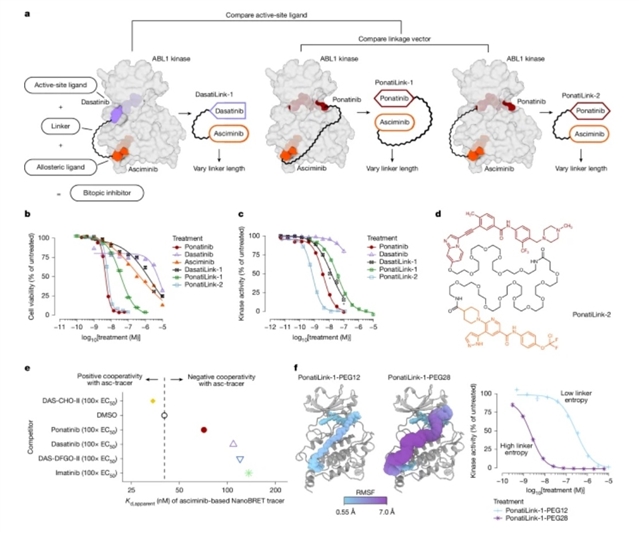
近日,美国加州大学旧金山分校Kevan M. Shokat团队报道了双位激酶抑制剂的设计方法。这一研究成果于2026年9月23日发表在《自然》杂志上。
传统激酶抑制剂面临效力与选择性之间的权衡,因为其亲和力取决于单个高度保守结合位点中有限的分子相互作用。双位点(bitopic)抑制剂通过结合同一靶标上的多个位点克服了这一局限。
研究组以ABL1和EGFR作为模型激酶,系统探究了双位点抑制剂特有的设计参数,包括配体选择、连接矢量和连接子长度,并表明它们通过配体间协同性和连接子熵影响效力。研究组应用该方法解决一个未满足的临床需求:现有ABL1抑制剂——ABL1是BCR::ABL1驱动白血病的重要靶点——受到耐药突变和脱靶效应的限制²。第三代抑制剂帕纳替尼可克服许多耐药突变,但心血管毒性限制了其临床应用。
研究组设计了一种双位点ABL1抑制剂PonatiLink-2,其对耐药突变体可维持或超过帕纳替尼的效力。此外,其在体外和体内均具有增强的治疗窗,从而能够提高给药剂量而不出现明显毒性。在BCR::ABL1驱动癌症的小鼠模型中,PonatiLink-2优于临床相关治疗:无论是与达沙替尼联用对抗野生型BCR::ABL1,还是作为单药对抗帕纳替尼耐药性疾病。这些发现表明,双位点设计方法是开发针对ABL1及其他靶点的高效、耐受性良好的临床抑制剂的一种有前景的策略。
附:英文原文
Title: A design approach for bitopic kinase inhibitors
Author: Stevenson, Jack W., Lou, Kevin, Reynolds, Joshua A., Outhwaite, Ian R., Huang, Kenneth, Sokirniy, Ivan, Peterson, Sky Y. J., Munir, Amir Z., Wang, Celine D., Inam, Haider, Gebauer, Emma L., Leyte-Vidal, Ariel, Grynyova, Anastasiia, Figueroa, Sydney M., Rees, Matthew G., Ronan, Melissa M., Salangsang, Fernando, Zeng, Yan, Steri, Veronica, Roth, Jennifer A., Shah, Neil P., Echeverria, Ignacia, ali, Andrej, Zhang, Ziyang, Moslehi, Javid J., Seeliger, Markus A., Pritchard, Justin R., Shokat, Kevan M.
Issue&Volume: 2026-09-23
Abstract: Traditional kinase inhibitors face a trade-off between potency and selectivity because their affinity depends on limited molecular interactions in a single highly conserved binding site. Bitopic inhibitors overcome this limitation by engaging multiple sites on the same target1. Here, using ABL1 and EGFR as model kinases, we systematically explore the bitopic-specific design parameters of ligand choice, linkage vector and linker length and show that they affect potency through inter-ligand cooperativity and linker entropy. We apply this approach to address an unmet clinical need: existing inhibitors of ABL1, an important target in BCR::ABL1-driven leukaemias, are constrained by resistance mutations and off-target effects2. The third-generation inhibitor ponatinib overcomes many resistance mutations, but cardiovascular toxicity limits its clinical use3. We design a bitopic ABL1 inhibitor, PonatiLink-2, that maintains or surpasses the potency of ponatinib against resistance mutants. Moreover, it has an enhanced therapeutic window in vitro and in vivo, which enables increased dosing without apparent toxicity. PonatiLink-2 outperforms clinically relevant treatments in mouse models of BCR::ABL1-driven cancer, both in combination with dasatinib against wild-type BCR::ABL1 and as a single agent against ponatinib-resistant disease. These findings indicate that the bitopic design approach is a promising strategy for developing potent, well-tolerated clinical inhibitors of ABL1 and other targets.
DOI: 10.1038/s41586-026-11056-8
Source: https://www.nature.com/articles/s41586-026-11056-8
官方网址:http://www.nature.com/