
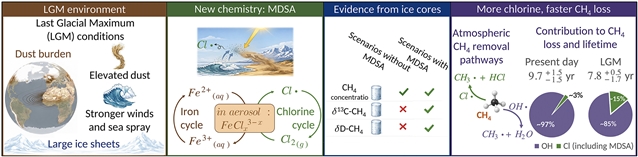
近日,西班牙国家研究委员会物理化学研究所“布拉斯·卡布雷拉”Alfonso Saiz-Lopez团队报道了末次冰盛期的大气甲烷寿命因粉尘介导的氯化学而缩短。这一研究成果发表在2026年9月17日出版的《科学》杂志上。
大气甲烷(CH4)在地球气候系统中起着核心作用,但在末次冰盛期(LGM)等高粉尘的冰期环境下,甲烷浓度下降的驱动因素仍不明确。此前解释均假定大气甲烷寿命与现代相当,认为甲烷变化由排放源驱动。近期研究表明,矿物粉尘与海盐气溶胶之间的相互作用会生成可消耗甲烷的氯自由基。
研究组表明,末次冰盛期大气甲烷寿命缩短至7.8年,较现代缩短20%。氯贡献了全球约15%的甲烷减少,为当前的4倍。该结果再现了冰芯甲烷同位素证据,证明无需大幅改变甲烷排放源,仅依靠强于以往认知的大气汇就可解释甲烷的波动变化,凸显了氯化学在冰期甲烷收支中这一长期被忽视的作用。
附:英文原文
Title: Atmospheric methane lifetime during the Last Glacial Maximum was reduced owing to dust-mediated chlorine chemistry
Author: Daphne Meidan, Carlos A. Cuevas, Julián Villamayor, Rafael P. Fernandez, Nicolás J. Cosentino, Samuel Albani, Natalie M. Mahowald, Andrea Spolaor, Juan Pablo Corella, Michaela Mühl, Jennifer Campos Ayala, Markus Grimmer, Jochen Schmitt, Hubertus Fischer, Alfonso Saiz-Lopez
Issue&Volume: 2026-09-17
Abstract: Atmospheric methane (CH4) plays a central role in Earth’s climate, yet the drivers of its decline during the high-dust conditions of glacial periods, such as the Last Glacial Maximum (LGM), remain uncertain. Previous explanations imply source-driven changes, assuming an atmospheric lifetime comparable to that of present day. Recent work shows that interactions between mineral dust and sea salt aerosols produce CH4-removing chlorine radicals. In this work, we show that during the LGM, CH4 lifetime shortened to 7.8 years, 20% lower than that of present day. Chlorine contributed ~15% of global CH4 loss, fourfold that of present day. Our results reproduce ice core CH4 isotopic evidence, demonstrating that stronger-than-assumed atmospheric sinks can explain CH4 variability without invoking substantial source changes, highlighting the overlooked role of chlorine chemistry in the glacial CH4 budget.
DOI: 10.1126/science.aec4071
Source: https://www.science.org/doi/10.1126/science.aec4071