
美国西奈山伊坎医学院Donghoon Lee等的最新研究提出了大脑疾病转录组易损性的单细胞图谱。2026年9月23日出版的《自然》杂志发表了这项成果。
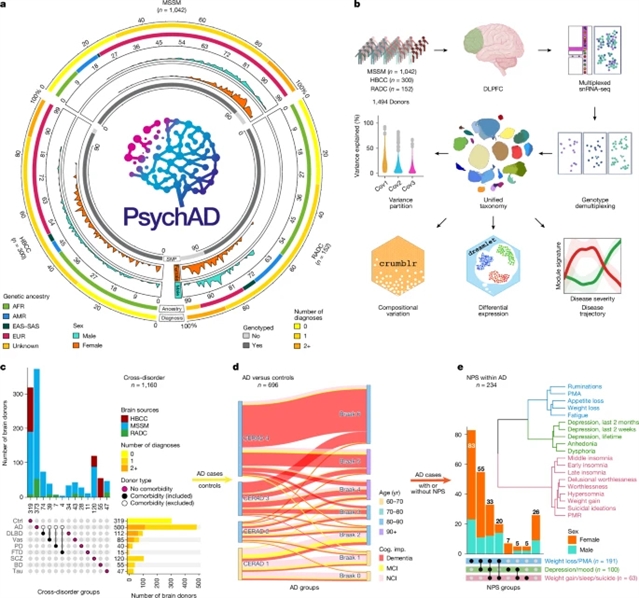
神经退行性和神经精神疾病给社会与公共卫生带来巨大负担。然而,研究人员对支撑这些高度复杂疾病的分子机制的理解仍然有限。在此,为了更深入地了解不同脑疾病的病因,研究人员使用来自1,494名独特供体的标本,构建了人类背外侧前额叶皮层的群体规模单细胞转录组图谱,包含超过630万个单细胞核。该队列包括神经正常对照,以及受八种常见复杂脑疾病影响的供体:阿尔茨海默病(AD)、弥漫性路易体病(DLBD)、血管性痴呆(Vas)、帕金森病(PD)、tau蛋白病、额颞叶痴呆、精神分裂症和双相情感障碍。研究人员表明,个体间变异占基因表达变异的相当大一部分。通过比较不同疾病间的转录组变异,他们揭示了富集于mRNA加工和蛋白质定位等基本细胞功能的普遍特征。在扣除这些跨疾病特征后,他们表明AD、DLBD、Vas和PD之间存在更强的遗传和转录组一致性。此外,他们表征了不同AD表型之间的转录组变异,这些变异不同于健康衰老中观察到的变异,揭示了更严重AD个体中神经元丰度减少,同时免疫和血管细胞群体增加。通过探索常伴随AD的神经精神症状(NPSs),他们发现与广泛NPSs相关的深层兴奋性神经元丰度增加。通过构建捕捉AD进展的转录组轨迹,他们将细胞类型特异性反应与AD早期和晚期联系起来。他们的疾病图谱提供了对神经退行性和神经精神疾病转录组景观的视角,揭示了涉及神经-免疫-血管系统的共享和不同过程,并识别了潜在的治疗干预靶点。
附:英文原文
Title: Single-cell atlas of transcriptomic vulnerability across brain disorders
Author: Lee, Donghoon, Koutrouli, Mikaela, Masse, Nicolas Y., Hoffman, Gabriel E., Kinrot, Seon, Wang, Xinyi, N. M., Prashant, Pjanic, Milos, Clarence, Tereza, Tsetsos, Fotios, Mathur, Deepika, Burstein, David, Therrien, Karen, Hong, Aram, Casey, Clara, Shao, Zhiping, Alvia, Marcela, Argyriou, Stathis, Fortes, Jennifer Monteiro, Murphy, Sarah R., Katsel, Pavel, Auluck, Pavan K., Barnes, Lisa L., Marenco, Stefano, Bennett, David A., Jensen, Lars Juhl, Girdhar, Kiran, Voloudakis, Georgios, Haroutunian, Vahram, Bendl, Jaroslav, Fullard, John F.
Issue&Volume: 2026-09-23
Abstract: Neurodegenerative and neuropsychiatric diseases impose a considerable societal and public health burden. However, our understanding of the molecular mechanisms underlying these highly complex conditions remains limited1,2. Here, to gain deeper insights into the aetiology of different brain diseases, we used specimens from 1,494 unique donors to generate a population-scale single-cell transcriptomic atlas of the human dorsolateral prefrontal cortex, comprising over 6.3million individual nuclei. The cohort includes neurotypical controls, as well as donors affected by eight common and complex brain disorders: Alzheimer’s disease (AD), diffuse Lewy body disease (DLBD), vascular dementia (Vas), Parkinson’s disease (PD), tauopathy, frontotemporal dementia, schizophrenia, and bipolar disorder. We show that interindividual variation accounts for a substantial portion of gene expression variation. By comparing transcriptomic variation across diseases, we reveal universal signatures enriched in basic cellular functions such as mRNA processing and protein localization. After discounting these cross-disease signatures, we show stronger genetic and transcriptomic concordance among AD, DLBD, Vas and PD. Furthermore, we characterize transcriptomic variation among different AD phenotypes, distinct from those observed in healthy ageing, revealing a reduction in neuronal abundance in individuals with more severe AD, coupled with an increase in immune and vascular cell populations. Exploring the neuropsychiatric symptoms (NPSs) that frequently accompany AD, we find an increased abundance of deep-layer excitatory neurons associated with a broad range of NPSs. By constructing transcriptome trajectories that capture AD progression, we implicate cell-type-specific responses in the early and late stages of AD. Our disease atlas provides a perspective of the transcriptomic landscape in neurodegenerative and neuropsychiatric disorders, shedding light on shared and distinct processes involving the neurological–immune–vascular systems, and identifying potential targets for therapeutic intervention.
DOI: 10.1038/s41586-025-09573-z
Source: https://www.nature.com/articles/s41586-025-09573-z
Nature:《自然》,创刊于1869年。隶属于施普林格·自然出版集团,最新IF:69.504
官方网址:http://www.nature.com/
投稿链接:http://www.nature.com/authors/submit_manuscript.html