
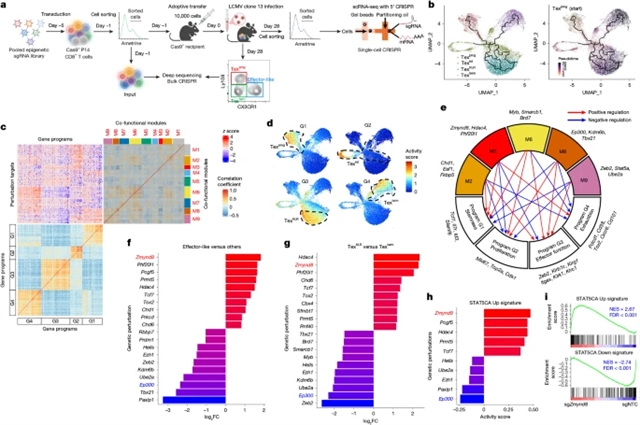
美国圣犹达儿童研究医院Chi Hongbo团队的研究发现靶向ZMYND8释放IL-2信号来覆盖T细胞衰竭。相关论文发表在2026年9月23日出版的《自然》杂志上。
CD8+ T细胞耗竭阻碍对慢性病毒感染和癌症的控制。这种功能低下状态的特征是高亲和力IL-2受体(IL-2R)和STAT5信号下调,以及从祖细胞耗竭型向终末耗竭型T细胞分化,而非向细胞毒性效应样细胞分化。介导IL-2R–STAT5信号减弱和效应样细胞分化丢失的表观遗传机制和调控网络仍不清楚。在此,研究人员利用针对表观遗传因子和IL-2信号调控因子的体内单细胞CRISPR筛选,揭示染色质阅读器ZMYND8拮抗IL-2R–STAT5信号,从而限制效应样状态并促进终末耗竭。ZMYND8表达由慢性抗原刺激上调,在CD8+ T细胞中靶向ZMYND8可促进中间耗竭T细胞和表达杀伤细胞凝集素样受体的耗竭T细胞。相应地,ZMYND8缺陷的CD8+ T细胞具有显著改善的抗病毒和抗肿瘤效果,尤其是在与IL-2治疗或免疫检查点阻断联合时。机制上,ZMYND8结合于Il2ra基因位点的活性增强子区域,这些区域同时被组蛋白乙酰转移酶p300占据,并抑制p300活性。p300的共缺失逆转了ZMYND8缺陷细胞中IL-2R表达增加和效应样细胞分化,表明ZMYND8抑制p300介导的转录激活,从而削弱IL-2R–STAT5信号。这些发现确立了一种表观遗传变阻器,施加“信号1”(慢性抗原刺激)诱导的对“信号3”(IL-2信号)的抑制,以强制T细胞耗竭,而ZMYND8缺失则释放效应样状态而非终末耗竭状态,并增强免疫治疗疗效。
附:英文原文
Title: Targeting ZMYND8 unleashes IL-2 signalling to override T cell exhaustion
Author: Wang, Yan, Shi, Hao, Chapman, Nicole M., KC, Anil, Sun, Renqiang, Song, Hao, Meng, Xiaoxi, Sun, Xiang, Chi, Hongbo
Issue&Volume: 2026-09-23
Abstract: CD8+ T cell exhaustion impedes control of chronic viral infection and cancer. This hypofunctional state is characterized by downregulation of the high-affinity IL-2 receptor (IL-2R) and STAT5 signalling, and differentiation from progenitor exhausted to terminally exhausted T cells rather than cytotoxic effector-like cells1,2,3. The epigenetic mechanisms and regulatory networks that mediate IL-2R–STAT5 signal attenuation and loss of effector-like cell differentiation remain unknown. Here, using in vivo single-cell CRISPR screens of epigenetic factors and IL-2 signalling regulators, we reveal that the chromatin reader ZMYND8 antagonizes IL-2R–STAT5 signals to restrain effector-like states while promoting terminal exhaustion. ZMYND8 expression was upregulated by chronic antigen stimulation, and targeting ZMYND8 in CD8+ T cells promoted both intermediate exhausted T cells and killer cell lectin-like receptor-expressing exhausted T cells. Accordingly, ZMYND8-deficient CD8+ T cells had markedly improved antiviral and antitumour effects, especially in combination with IL-2 therapy or immune checkpoint blockade. Mechanistically, ZMYND8 bound to the active enhancer regions of the Il2ra gene locus that were co-occupied by histone acetyltransferase p300 and suppressed p300 activity. Co-deletion of p300 reversed increased IL-2R expression and effector-like cell differentiation in ZMYND8-deficient cells, suggesting that ZMYND8 represses p300-mediated transcriptional activation to curtail IL-2R–STAT5 signalling. These findings establish an epigenetic rheostat imposing ‘signal 1’ (chronic antigen stimulation)-induced suppression of ‘signal 3’ (IL-2 signalling) to enforce T cell exhaustion, with ZMYND8 deletion unleashing effector-like over terminally exhausted states and enhancing immunotherapeutic efficacy.
DOI: 10.1038/s41586-026-11059-5
Source: https://www.nature.com/articles/s41586-026-11059-5
Nature:《自然》,创刊于1869年。隶属于施普林格·自然出版集团,最新IF:69.504
官方网址:http://www.nature.com/
投稿链接:http://www.nature.com/authors/submit_manuscript.html