
近日,德国马克斯·普朗克聚合物研究所Weil, Tanja团队研究了多通道肽纳米原纤维中的序列编码六边形晶格。2026年9月23日出版的《自然》杂志发表了这项成果。
生物物质中的结构复杂性源于分子信息,这些信息编码了跨长度尺度的超分子组装。
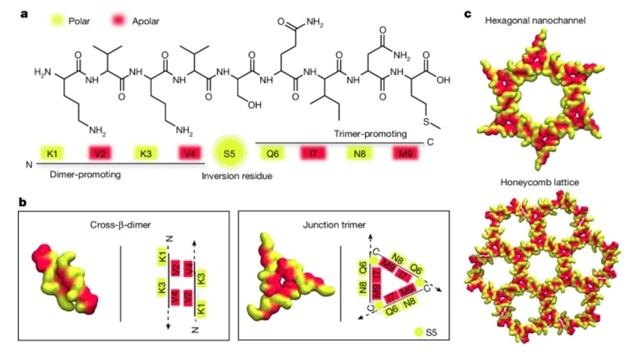
研究组表明,极简的九残基肽能够编码离散的侧向相互作用基序,从而指导超分子组织。这些基序产生六边形孔,并层级化地拼装成具有确定拓扑的多通道纳米原纤维。序列编码的两亲性结合了交叉β二聚体、一个反演点和一个三聚体连接,以形成互补界面,这些界面将侧向生长与轴向堆叠耦合,产生具有连续约5 nm溶剂可及纳米通道的蜂窝状晶格。冷冻电镜解析了该超分子结构,并表明晶格对称性和孔几何形状在不同变体间得以保持。
系统性扰动建立了序列-结构规则,将残基位置与超分子对称性、晶格传播和通道拓扑联系起来。分子动力学模拟和振动光谱表明,这些通道仍可被水接近,并表现出序列可调的水合作用。这些发现确立了最小的、序列编码的相互作用层级能够程序化长程超分子有序,为短肽如何编码复杂的、对称性定义的架构提供了一个通用框架。
附:英文原文
Title: Sequence-encoded hexagonal lattices in multichannel peptide nanofibrils
Author: Gaanin, Jasmina, Mazzotta, Francesca, Baptista, Luis Andre, Stoyanov, Nikolay, Schmidt, Matthias, Alleva, Nico, Thummaraj, Thunchanok, Bonnicel, Fanny, Zhou, Cong, Gao, Lei, Mnch, Jan, Bonn, Mischa, Fndrich, Marcus, Lieberwirth, Ingo, Cortes-Huerto, Robinson, Landfester, Katharina, Weil, Tanja
Issue&Volume: 2026-09-23
Abstract: Structural complexity in biological matter arises from molecular information that encodes supramolecular assembly across length scales1,2,3. Here we show that minimal nine-residue peptides can encode discrete lateral interaction motifs that direct supramolecular organization. These motifs generate hexagonal pores and hierarchically tile into multichannel nanofibrils with defined topology. Sequence-encoded amphiphilicity combines a cross-β-dimer, an inversion point and a trimeric junction to create complementary interfaces that couple lateral growth to axial stacking, yielding honeycomb lattices with continuous approximately 5-nm solvent-accessible nanochannels. Cryo-electron microscopy resolves the supramolecular architecture and shows that lattice symmetry and pore geometry are preserved across variants. Systematic perturbations establish sequence–structure rules linking residue position to supramolecular symmetry, lattice propagation and channel topology. Molecular dynamics simulations and vibrational spectroscopy show that the channels remain water accessible and show sequence-tunable hydration. These findings establish that a minimal, sequence-encoded interaction hierarchy can programme long-range supramolecular order, providing a general framework for how short peptides can encode complex, symmetry-defined architectures4,5,6,7,8,9,10,11,12.
DOI: 10.1038/s41586-026-11016-2
Source: https://www.nature.com/articles/s41586-026-11016-2
官方网址:http://www.nature.com/