
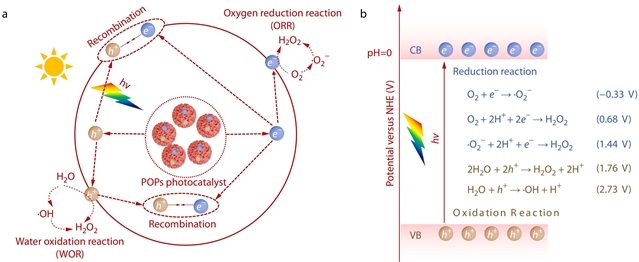
近日,华中科技大学谭必恩团队报道了用于光催化过氧化氢生产的多孔有机聚合物:最新进展和未来前景。2026年8月5日出版的《中国高分子科学杂志》发表了这项成果。
过氧化氢(H2O2)是一种绿色化学品,在化学合成和环境修复等领域具有广泛的应用。尽管工业蒽醌法仍是主流生产方式,但太阳能驱动的光催化H2O2生产已成为一种有前景的策略,可用于补充或优化现有生产模式,尤其适用于现场应用场景。在各种多孔有机聚合物(POPs)中,共价有机框架(COFs)和共价三嗪框架(CTFs)因其模块化构建和精确的分子水平可调性,作为一类重要平台而受到广泛关注。
研究组系统总结了基于POPs的光催化剂的最新研究进展,重点聚焦于COFs和CTFs的结构与功能化修饰。首先阐述了光催化H2O2生产的基本原理和现有挑战。随后,讨论了各类POPs材料在光催化领域的研究现状。
以COFs和CTFs为代表,研究组进一步重点介绍了先进的改性策略,包括给体-受体(D-A)结构设计、官能团工程以及异质结构构建。这些策略能有效促进电荷分离、延长载流子寿命并改善传质,从而提升太阳能到化学能的转化效率。最后,研究组总结了该领域的研究现状,并对基于POPs的光催化H2O2生产的未来研究方向提出了展望。
附:英文原文
Title: Porous Organic Polymers for Photocatalytic Hydrogen Peroxide Production: Recent Advances and Future Perspectives
Author: Jia-Wei Xie, Bi-En Tan
Issue&Volume: 2026-08-05
Abstract: Hydrogen peroxide (H2O2) is a green chemical with extensive applications in chemical synthesis and environmental remediation. While the industrial anthraquinone process remains the dominant production method, solar-driven photocatalytic H2O2 production has emerged as a promising strategy to complement or optimize current production models, particularly for on-site applications. Among various porous organic polymers (POPs), covalent organic frameworks (COFs), and covalent triazine frameworks (CTFs) have attracted significant attention as a premier platform due to their modular construction and precise molecular-level tunability. Here, we systematically summarize recent progress in POPs-based photocatalysts, with a primary focus on the structural and functional modification of COFs and CTFs. We first elucidate the fundamental principles and existing challenges of photocatalytic H2O2 production. Subsequently, the research landscape of various POPs materials in photocatalysis is discussed. Taking COFs and CTFs as representative examples, we then highlight advanced modification strategies, including the design of donor-acceptor (D-A) structures, functional group engineering, and the construction of heterostructures. These strategies effectively facilitate efficient charge separation, extend carrier lifetimes, and improve mass transport, thereby enhancing solar-to-chemical conversion efficiency. Finally, we summarize the current state of the field and offer perspectives on future research directions for POPs-based photocatalytic H2O2 production.
DOI: 10.1007/s10118-026-3697-3
Source: https://www.cjps.org/en/article/doi/10.1007/s10118-026-3697-3/
Chinese Journal of Polymer Science:《中国高分子科学杂志》,创刊于1983年。隶属于中国化学会,最新IF:4.3
官方网址:https://www.cjps.org/
投稿链接:https://mc03.manuscriptcentral.com/cjps