
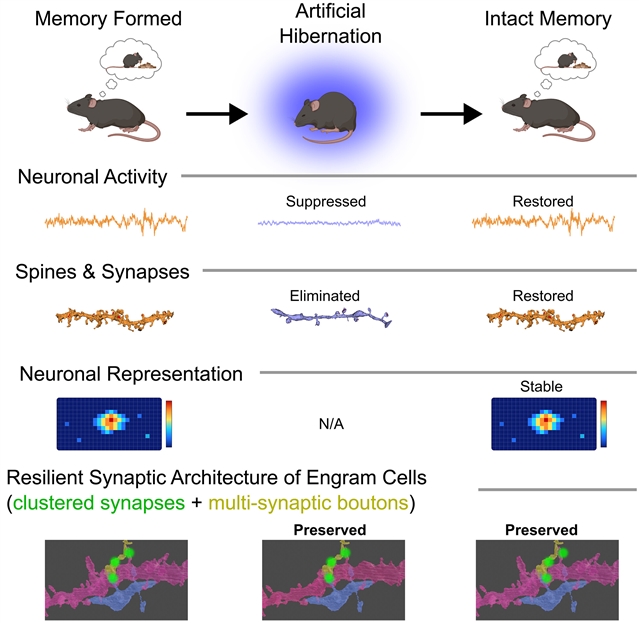
为了阐明记忆保留背后的结构痕迹,该研究团队建立了人工冬眠的非主题模型。冬眠期间,海马神经元的活动大幅减少,树突棘和突触大量消失。尽管有这些变化,他们的记忆和相关的海马体神经元表征仍然完好无损。研究人员发现,在冬眠期间,以与多突触钮扣的突触接触为特征的脊髓子集得以维持。这些发现表明突触印痕结构,而不是更大的脊椎本身,对网络重塑具有弹性,并与长期记忆保持有关。
据悉,记忆在突触层面留下持久的物理变化。虽然稳定、较大的树突棘被认为支持记忆,但树突棘的高周转率和记忆形成后神经元表征的漂移表明了其他可能性。
附:英文原文
Title: Artificial hibernation reveals synaptic engram architecture associated with memory retention
Author: Y. J. Lin, A. Takahashi-Nakazato, K. Tsutsumi, T. Takahashi, D. Mercier, H. Ashitomi, M. C. Chiang, M. Haberl, M. Uytiepo, A. Maximov, Y. Makino, T. Nemoto, R. Enoki, A. Hirano, K. Soga, S. Looprasertkul, N. Ohno, Y. Kubota, T. Sakurai, K. Z. Tanaka
Issue&Volume: 2026-08-13
Abstract: Memories leave lasting physical changes at the synaptic level. Although stable, larger spines are thought to support memory, the high turnover of dendritic spines and the drifting of neuronal representations after memory formation suggest alternative possibilities. To elucidate the structural trace underlying memory retention, we used a mouse model of artificial hibernation. During hibernation, hippocampal neurons exhibited a substantial reduction in their activity and an extensive elimination of dendritic spines and synapses. Despite these changes, their memory and associated hippocampal neuronal representations remained intact. We found that a subset of spines characterized by synaptic contacts with multisynaptic boutons is maintained during hibernation. These findings suggest that synaptic engram architecture, rather than larger spines per se, is resilient to network remodeling and associated with long-term memory retention.
DOI: aee7004
Source: https://www.science.org/doi/10.1126/science.aee7004