
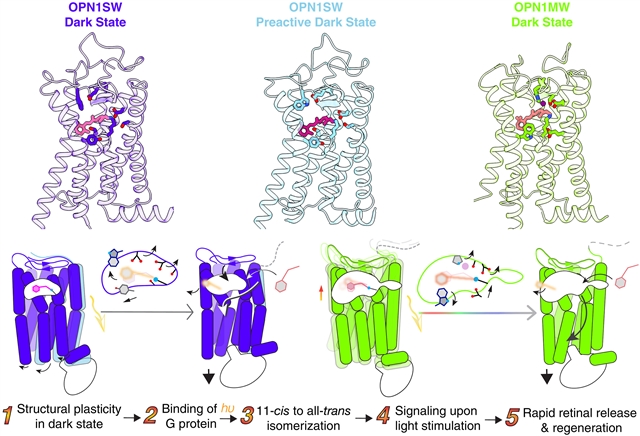
研究团队报道了人类蓝敏(OPN1SW)和绿敏(OPN1MW)视锥蛋白在黑暗适应状态下的低温电子显微镜结构,结合飞秒分辨率光谱,功能分析和先进的模拟。这些数据揭示了人类视蛋白中不同的发色团稳定机制和GPCR微开关基序中的特定序列适应,强调了它们的结构可塑性和不同的激活机制。这些发现描述了满足白天视觉需求的进化改进的分子基础。
研究人员表示,光视觉,包括在日光下的快速运动和颜色感知,是由视锥蛋白介导的,这是一种特殊的G蛋白偶联受体(GPCRs)。尽管共享相同的发色团,但这三种受体亚型吸收可见光谱中不同波长的光。控制其光谱特性和异常快速反应的分子机制在很大程度上仍然未知。
附:英文原文
Title: Illuminating the molecular basis of human daylight vision
Author: Sarah L. Schmidt, Jakub Dostal, Saumik Sen, Andrej Hovan, Deborah Walter, Martin V. Appleby, Asato Kojima, Hideaki E. Kato, John H. Beale, Miroslav Kloz, Gebhard F. X. Schertler, Polina Isaikina
Issue&Volume: 2026-06-25
Abstract: Photopic vision, including fast motion and color perception in daylight, is mediated by cone opsins, specialized G protein–coupled receptors (GPCRs). Despite sharing the same chromophore, the three receptor subtypes absorb light at different wavelengths of the visible spectrum. The molecular mechanisms governing their spectral properties and exceptionally rapid responses remain largely unknown. We report cryo–electron microscopy structures of the human blue-sensitive (OPN1SW) and green-sensitive (OPN1MW) cone opsins in their dark-adapted states, combined with femtosecond-resolution spectroscopy, functional assays, and advanced simulations. The data reveal distinct chromophore stabilization mechanisms across human visual opsins and specific sequence adaptations in the GPCR microswitch motifs, underlining their structural plasticity and distinct activation mechanisms. These findings delineate the molecular basis of the evolutionary refinements fulfilling the needs of vision in daylight.
DOI: adz3624
Source: https://www.science.org/doi/10.1126/science.adz3624